65337edc2x

Leave Your Message

China Top Kitchen Canisters Manufacturers for Global Buyers?

China has become a major sourcing destination for Kitchen Canisters, serving retailers, hospitality suppliers, and private-label brands worldwide. Its manufacturing base includes stainless steel, glass, ceramic, bamboo, and food-grade plastic options. Buyers can find practical solutions for coffee, tea, flour, sugar, spices, and dry snacks.

Marie Kondo, a recognized organizing expert, says, “The objective of storage is to give every item a home.” That principle applies directly to Kitchen Canisters. A well-designed container should protect freshness, improve cabinet visibility, and make daily preparation easier. Small details matter. Lid fit matters. So does labeling.

This guide examines China’s leading Kitchen Canisters manufacturers and the factors global buyers should review before choosing a supplier. It considers material safety, sealing performance, production capacity, customization, packaging, quality control, and export experience. Factory audits and independent testing can strengthen confidence, but paperwork alone cannot replace product inspection. That deserves attention.

Some manufacturers excel at high-volume orders, while others support lower minimum quantities and flexible designs. Their strengths are not identical. Buyers should compare samples, factory communication, lead times, and after-sales support before signing agreements. A polished catalog may hide inconsistent finishing or weak seals. That risk is real.

The following outline is designed for practical sourcing decisions. It helps global buyers distinguish attractive claims from measurable performance. No supplier is perfect. Careful verification remains essential.

China Top Kitchen Canisters Manufacturers for Global Buyers?

What Defines a Top Kitchen Canister Manufacturer in China?

A top kitchen canister manufacturer in China is defined by controlled details, not a polished showroom. The ISO Survey 2023 reported more than 1.2 million ISO 9001 certificates in China. Yet certification alone cannot prove reliable canisters. Buyers should examine batch records, material certificates, and corrective-action reports. A capable factory identifies stainless steel grades, plastic resins, and silicone gasket specifications clearly. It should also provide food-contact test results from an accredited laboratory. Small details matter. Check lid alignment, gasket compression, hinge cycles, and odor after washing. Request samples from different production batches, not one carefully prepared sample.

Export experience also requires measurable evidence. The WTO World Trade Statistical Review 2024 stated that China supplied 14.2% of global merchandise exports in 2023. This scale supports strong logistics networks, but it does not guarantee every supplier performs consistently. A serious manufacturer shares realistic lead times, carton drop-test results, and lot-level traceability. It should explain how defects are isolated before shipment. Factory audits should include storage areas, incoming inspection, and final packing lines. A glossy audit can still miss weak records. That is an uncomfortable point. Buyers should compare actual production evidence against sales promises, while allowing room for improvement in design, packaging, and quality controls.

Key Types of Kitchen Canisters Made for Global Buyers

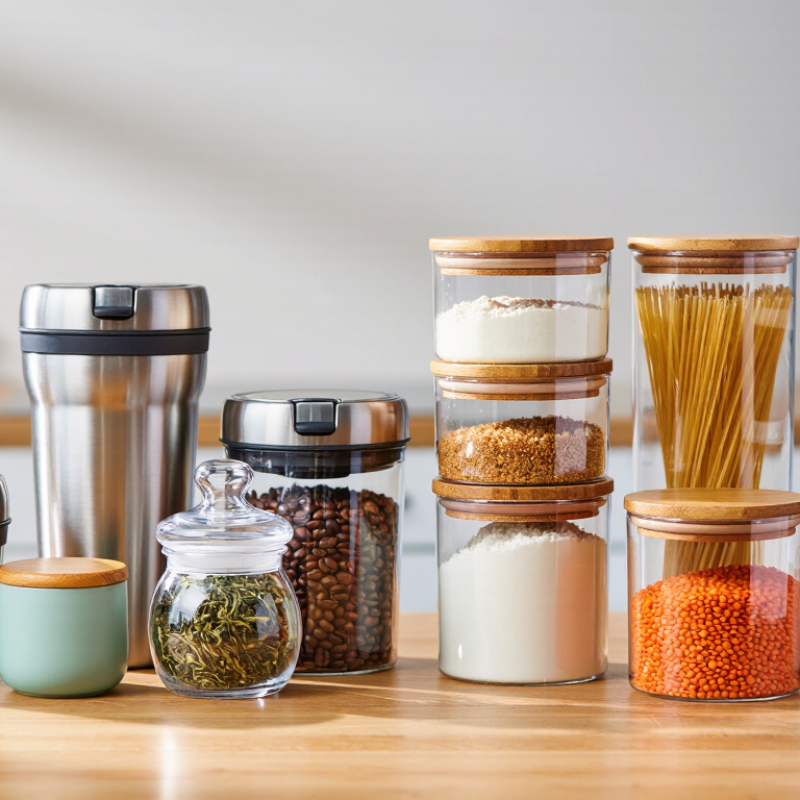
Kitchen canisters made for global buyers come in glass, stainless steel, ceramic, and food-grade plastic. Each material serves a different storage need. Glass shows the contents clearly. It suits flour, coffee, tea, and dried herbs. Stainless steel handles busy kitchens and frequent washing. It also blocks light better than clear glass. Ceramic canisters add weight and a traditional appearance, but their lids or surfaces may chip during transport. Plastic models are lighter and often more affordable, although they can retain odors over time.

The lid design matters as much as the container body. Airtight silicone seals help protect rice, sugar, and powdered ingredients from humidity. Clamp lids create a strong closure, while screw lids support efficient stacking. Bamboo or wood lids look natural, but buyers should check moisture resistance and coating safety. Not every lid survives.

For overseas purchasing, reliable manufacturers should provide clear capacity options, material specifications, and food-contact test documents. Buyers can request sample units before placing large orders. Check the seal after repeated opening, inspect the rim for sharp edges, and measure whether labels fit smoothly. Carton strength also deserves attention, especially for glass products. Batch color may vary slightly in ceramic production. That detail is easy to overlook. A careful supplier should explain acceptable tolerances, production timelines, and replacement procedures before the order moves forward.

How to Evaluate Chinese Kitchen Canister Manufacturers

How to Evaluate Chinese Kitchen Canister Manufacturers

China remains a major supplier of household kitchenware, according to UN Comtrade data for HS 3924. However, export volume alone cannot prove manufacturing quality. Buyers should examine factory experience, production equipment, and quality records. A polished showroom can mislead.

Request recent audit reports, business licenses, and batch inspection records. Check whether the manufacturer controls plastic, glass, silicone, and metal suppliers. For food-contact products, ask for migration test results under applicable standards, such as EU food-contact rules or FDA requirements. Intertek’s food-contact testing guidance highlights overall migration, specific migration, and heavy-metal testing as key risk areas. These documents should identify the exact material, test temperature, and production batch.

Inspect the canister physically. Test lid sealing with colored water, repeat opening cycles, and expose samples to heat and humidity. Check gasket odor after washing. ISO 2859-1 sampling procedures can support consistent acceptance decisions, although many factories apply them too casually. Clarify the acceptable defect level in writing.

Grand View Research and other market reports show continuing demand for organized food storage, but demand does not guarantee durable products. MOQ, mold ownership, replacement parts, and lead times also deserve attention. I would request samples from two production batches, not one. This adds cost, but a single perfect sample proves very little. Supplier communication matters too. Slow answers often reveal weak traceability.

Quality Standards, Materials, and Customization Options

China Top Kitchen Canisters Manufacturers for Global Buyers?

Quality starts with measurable details, not attractive product photos. Experienced buyers should request food-contact test reports, material declarations, and batch inspection records. Reliable factories check lid fit, sealing pressure, surface finish, and dimensional tolerance. A canister that looks perfect may still leak after repeated washing. That is easy to miss.

Stainless steel 304 suits dry foods and daily kitchen use. Stainless steel 316 offers stronger corrosion resistance, but it often costs more.

Borosilicate glass gives buyers clear visibility and better odor resistance. Bamboo lids add warmth, yet they need moisture protection and careful finishing.

Silicone gaskets should remain flexible after temperature changes. Ask for migration testing where required by the destination market.

Customization can cover capacity, lid shape, color, engraving, labels, gift packaging, and inner dividers. Small details matter. A 900 ml canister may fit a retail shelf better than a 1-liter design.

Request pre-production samples before approving bulk manufacturing. Check the printed color under natural light, not only on a screen. Confirm carton strength with drop testing and humidity checks.

One practical weakness is that factories may show strong sample quality but uneven later batches. Independent inspections reduce that risk, although they cannot replace clear specifications. Buyers should record every approved measurement, material grade, and tolerance in writing.

Ordering, Certification, and Export Considerations for Buyers

China’s kitchen canister sector serves buyers across retail, hospitality, and food-service markets. According to the ISO Survey 2023, 1,265,216 ISO 9001 certificates were recorded worldwide. However, a factory certificate does not prove every canister is safe or consistent. Buyers should inspect production lines, sealing tests, material records, and batch samples before placing large orders.

Request quotations with clear specifications. Include capacity, steel or glass grade, lid structure, gasket material, logo method, carton strength, and acceptable defect limits. For food-contact products, ask for migration testing from an independent laboratory. European shipments may require compliance with Regulation (EC) No. 1935/2004 and related good manufacturing rules. U.S. shipments should be checked against applicable FDA food-contact requirements. Documents matter.

Small details often reveal export readiness. Ask for a pre-production sample, a packing video, and a written inspection plan. Confirm HS classification, Incoterms, payment stages, loading port, and shipment insurance. The International Chamber of Commerce reports that Incoterms rules define buyer and seller responsibilities, but they do not replace a sales contract. That distinction is easy to miss. My practical concern is simple: many buyers approve attractive samples, then discover thinner walls or weaker seals in mass production. Independent inspection before loading costs money, yet one failed container costs far more. Suppliers should also provide traceable batch codes and corrective-action records, even when the buyer does not request them.

China Top Kitchen Canisters Manufacturers for Global Buyers? - Ordering, Certification, and Export Considerations for Buyers

Buyer Consideration Practical Data Dimension Common Requirement or Benchmark Documents or Evidence to Request Export and Ordering Notes
Product Material Body, lid, seal, and surface finish Common options include stainless steel, glass, ceramic, tinplate, bamboo, wood, and food-contact plastics such as PP or silicone components. Material specification sheet, food-contact declaration, coating specification, and component list. Confirm that every food-contact component is covered, including gaskets, inner coatings, adhesives, printing inks, and decorative finishes.
Food-Contact Compliance Destination-market regulatory coverage For the European Union, food-contact articles are generally assessed under Regulation (EC) No. 1935/2004. Plastic parts may also require compliance with Regulation (EU) No. 10/2011. Declaration of Compliance, migration-test report, test-method details, and traceability information. The applicable rules depend on the material, food type, temperature, contact time, and destination country. A general “food safe” statement is not sufficient evidence.
United States Requirements Material and intended-use assessment Food-contact materials placed on the United States market should be evaluated against applicable U.S. Food and Drug Administration requirements, including relevant sections of Title 21 CFR. Supplier compliance statement, supporting laboratory report, formulation information where applicable, and intended-use conditions. Check whether the product is used for dry food, acidic food, oily food, hot filling, refrigeration, or repeated use, because conditions can affect compliance.
European Chemical Requirements Restricted substances and articles Products supplied to the EU may require assessment under REACH restrictions. Articles containing applicable substances of very high concern may trigger communication obligations. REACH declaration, restricted-substance statement, material composition information, and test reports when requested. Request current documentation for coatings, plastics, rubber seals, pigments, plating, and metal surface treatments rather than relying only on the finished-product description.
Quality Management Factory process control An ISO 9001 certificate can indicate a documented quality-management system, but it does not by itself prove food-contact compliance or product quality. Certificate scope, audit date, inspection procedure, quality manual summary, and corrective-action records when available. Verify that the certificate holder, manufacturing site, and product scope correspond to the facility actually producing the canisters.
Testing Plan Performance and safety tests Typical checks include dimensional inspection, lid fit, leakage, seal compression, odor and taste transfer, coating adhesion, corrosion resistance, drop resistance, and migration testing where applicable. Pre-production sample report, third-party laboratory report, internal inspection checklist, and corrective-action record. Approve a sealed reference sample and written acceptance criteria before mass production. Test results should identify the tested material, model, batch, and laboratory.
Capacity and Dimensions Volume, tolerance, and usable space Specify nominal capacity in millilitres or litres, external dimensions in millimetres, net weight, opening diameter, and usable internal volume. Technical drawing, dimension sheet, tolerance table, and approved sample. Capacity may vary with wall thickness, lid design, and internal shape. Confirm whether the stated volume is nominal, brimful, or usable capacity.
Minimum Order Quantity Standard versus customized production Standard items usually require fewer production changes than fully customized items. Custom moulds, special colours, printed artwork, and custom packaging may increase the minimum order quantity. Quotation with quantity tiers, tooling charge, sample charge, colour surcharge, and packaging cost. Ask for pricing at several quantity levels and confirm whether the quoted quantity applies per design, colour, size, or complete mixed shipment.
Sampling and Approval Sample stages and approval control A practical sequence is: visual sample, functional sample, pre-production sample, and shipment inspection sample. Sample approval form, signed specification, approved artwork, colour reference, and inspection standard. Do not approve mass production from photographs alone. Record any permitted deviations for colour, dimensions, printing position, and surface marks.
Packaging Configuration Unit pack, carton pack, and pallet data Confirm product protection, carton dimensions, units per carton, gross weight, net weight, carton marks, and palletization method. Packing list, carton specification, packaging test record, product photographs, and pallet diagram where applicable. Glass and ceramic canisters need stronger protection against impact. Confirm whether cartons are suitable for container stacking and long-distance handling.
Shipping Terms Incoterms and cost responsibility Common arrangements include EXW, FOB, CFR, CIF, and DAP. Each term allocates transport, insurance, customs, and delivery responsibilities differently. Pro forma invoice showing the agreed Incoterm, named place or port, currency, validity period, and included charges. State the Incoterms version and named location clearly. Confirm whether export clearance, destination charges, insurance, and import taxes are included.
HS Classification Material-based customs classification Kitchen canisters may fall under different tariff headings depending on whether the principal material is glass, metal, ceramic, plastic, or another material. Proposed HS code, product composition, commercial invoice description, and customs broker confirmation. HS classification is determined by the importing customs authority. Confirm the code before shipment because duty rates and import controls can differ by country.
Export Documentation Core shipment file A typical file includes commercial invoice, packing list, transport document, purchase order, certificate of origin when required, and product compliance documents. Final invoice, packing list, bill of lading or air waybill, certificate of origin, inspection report, and declarations required by the destination market. Ensure that product descriptions, quantities, weights, carton counts, country of origin, and HS codes are consistent across all documents.
Labelling and Marking Product, carton, and regulatory information Labels may need product identity, material information, capacity, care instructions, country of origin, importer details, and applicable recycling or disposal information. Final artwork, label translation, marking layout, carton artwork, and destination-market labelling checklist. Requirements vary by destination and product composition. Obtain written approval for artwork before printing and verify mandatory language requirements.
Production Timeline Sampling, tooling, production, and shipping schedule The overall schedule normally includes quotation, sample approval, tooling if needed, raw-material preparation, production, inspection, packing, and international transit. Confirmed production schedule, milestone dates, inspection date, estimated ready-to-ship date, and logistics booking plan. Treat quoted lead times as planning estimates until the specification, deposit, artwork, and sample approval are complete. Seasonal demand and custom tooling can extend the schedule.
Final Inspection Acceptance criteria and inspection level Inspect quantity, dimensions, appearance, function, packaging, labelling, and documentation before shipment. AQL-based sampling may be used when agreed in advance. Inspection report, defect classification, photographic record, carton count, and shipment release approval. Define critical, major, and minor defects in the purchase contract. Payment balance and shipment release should follow the agreed inspection procedure.
After-Sales and Claims Defect handling and traceability A documented claim process should identify batch numbers, defect rates, photographs, affected cartons, corrective action, and replacement or credit terms. Warranty terms, batch-traceability format, complaint form, corrective-action procedure, and agreed compensation policy. Retain a reference sample and shipment records for each batch. Agree on the notification period and evidence required for transport damage or quality claims.
Buyer note: Certification and import requirements depend on the canister material, intended food use, destination country, packaging, and sales channel. Confirm the final requirements with the destination-country regulator, customs broker, and an accredited testing laboratory before placing a production order.