




Choosing the right China best ceramic mug manufacturer requires more than comparing factory prices. Global buyers need dependable quality, clear communication, and evidence of responsible production. A successful Ceramic Mug supplier should understand clay preparation, glaze control, kiln temperatures, and practical packing requirements. Small details matter. A hairline crack near the handle can become a costly customer complaint.
Ceramic historian and educator Susan Peterson wrote, “Ceramics is the art and science of making objects from clay.” Her statement remains useful for international sourcing. A mug is not only a printed product. It is a fired object shaped by material science, craftsmanship, and repeated testing. Buyers should review production samples, food-contact documentation, glaze consistency, handle strength, and carton protection before placing larger orders. Factory photographs help, but an independent inspection often reveals more.
The strongest manufacturers usually provide clear minimum order quantities, stable lead times, and realistic customization advice. They can explain whether a logo needs screen printing, transfer decoration, or underglaze treatment. They should also discuss breakage rates honestly. Perfect results are promised too easily. That deserves reflection.
This guide examines China’s leading Ceramic Mug manufacturers for global buyers. It considers production capability, customization, export experience, quality systems, packaging, and communication. It does not treat the lowest quotation as the best answer. A cheaper mug may hide weaker glazing, thinner walls, or higher transport losses. The right partner balances cost with reliability, visual appeal, and long-term customer trust.
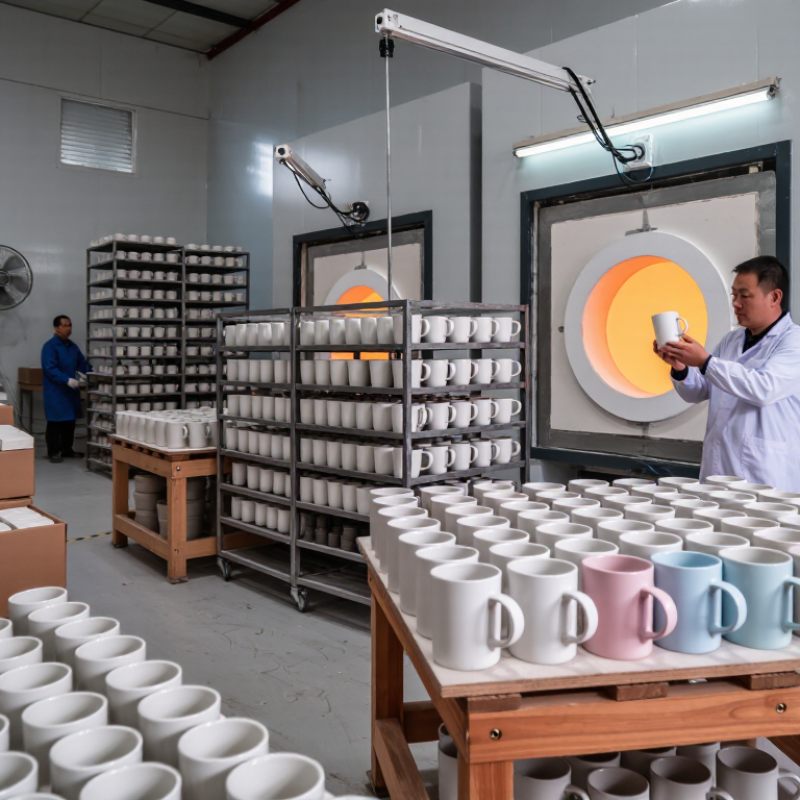
A reliable ceramic mug manufacturer in China proves capability through consistent work, not attractive catalog photos. Experience appears in practical details: stable clay bodies, even wall thickness, smooth rims, and accurate handle placement. Ask for production samples from different batches. One perfect sample is not enough. Real confidence comes from repeatable results.
Professional manufacturers explain their process clearly. They can discuss raw material control, kiln temperature, glaze behavior, and decoration limits. Their quality team should inspect dimensions, surface defects, color variation, and packaging strength. For mugs used with beverages, request current food-contact test reports for the target market. Check whether the reports match the actual glaze and clay body. Documents can be copied. Traceability matters more.
Communication also reveals reliability. A dependable factory confirms tolerances, sample timelines, carton specifications, and corrective actions in writing. Factory visits, video inspections, and independent testing can verify those claims. No factory is flawless. The better partner admits a failed firing or delayed shipment, then explains the remedy. I have found that honest limitations often create fewer problems than confident promises. Buyers should review pilot orders before committing to large volumes, because small defects become expensive when multiplied.
| Reliability Dimension | Practical Buyer Benchmark | Evidence to Request | Why It Matters for Global Buyers | Assessment |
|---|---|---|---|---|
| Food-Contact Safety | Finished mugs should be tested against the legal requirements of the destination market, including limits for lead and cadmium migration where applicable. | Recent laboratory test reports identifying the exact product, glaze, decoration, and test method. | Ceramic food-contact requirements differ by country. A report for an un-decorated sample may not cover printed or metallic-decorated versions. | Essential |
| Regulatory Documentation | The manufacturer should clearly identify which requirements are covered, such as applicable United States, European Union, United Kingdom, or other national rules. | Declaration of compliance, material specifications, test scope, and traceable batch information. | Correct documentation reduces customs, retailer, and product-liability risks. | Essential |
| Quality Management System | A documented quality system with controlled procedures for incoming materials, production, inspection, nonconformities, and corrective actions. | Valid quality-management certificate, internal procedures, inspection records, and corrective-action examples. | Formal controls help reduce variation between approved samples and mass production. | High Priority |
| Production Traceability | Raw materials, glaze batches, decoration lots, firing records, and finished cartons should be traceable to a production date or lot number. | Sample lot codes, production records, carton labels, and the factory’s recall or complaint procedure. | Traceability allows faster investigation if a safety or quality issue occurs after shipment. | High Priority |
| Dimensional Consistency | Critical dimensions, capacity, weight, handle position, base diameter, and logo placement should be defined by approved drawings and tolerances. | Technical drawing, golden sample, inspection checklist, and measurement records from a production batch. | Consistent dimensions improve packing efficiency, customer experience, and compatibility with lids or accessories. | High Priority |
| Glaze and Decoration Durability | Surface appearance should remain within agreed acceptance criteria after applicable washing, abrasion, and chemical-resistance tests. | Test method, acceptance criteria, decorated-sample results, and approved color standard. | Poorly controlled decoration can lead to fading, scratching, pinholes, crazing, or customer complaints. | High Priority |
| Thermal and Mechanical Performance | The product should be evaluated for cracking, handle strength, rim defects, and thermal-shock performance according to its intended use. | Product specification, test protocol, sample results, and intended-use statement, such as hot beverages or food service. | Testing should reflect actual use rather than relying only on visual inspection. | High Priority |
| Pre-Shipment Inspection | A documented inspection should cover appearance, dimensions, function, packaging, quantity, and labeling before release. | Inspection report, sampling plan, defect classification, product photographs, and approval records. | Independent or buyer-approved inspection helps identify defects before international shipment. | High Priority |
| Packaging and Transit Protection | Packaging should be designed for fragile ceramic products and validated for the selected transport method and stacking conditions. | Packaging specification, carton dimensions, drop or vibration test results when required, and loading photographs. | Breakage can create higher total costs than the original unit-price difference. | Essential |
| Capacity and Export Experience | The supplier should demonstrate suitable kiln capacity, production scheduling, export documentation, and experience with the buyer’s destination requirements. | Factory audit, production plan, sample shipping documents, lead-time record, and references for comparable product types without disclosing confidential customer data. | Operational capability supports stable delivery during seasonal demand and repeat orders. | High Priority |
| Communication and Corrective Action | The supplier should provide clear specifications, realistic lead times, written approvals, and a documented process for handling defects or claims. | Purchase-order workflow, sample-approval records, response-time expectations, claim procedure, and corrective-action report. | Transparent communication is a practical indicator of how efficiently problems will be managed after production begins. | High Priority |